
021 202 0626
Endoscopic Haemostasis: A Key to Managing Bleeding Lesions

Endoscopic Haemostasis: A Key to Managing Bleeding Lesions

Introduction

The medical field has experienced significant advancements in terms of diagnostic and therapeutic procedures.

One of the revolutionary advancements has been the advent of endoscopy, which allows direct visualization and treatment of internal structures.

When it comes to the management of gastrointestinal (GI) bleeding, endoscopic haemostasis has emerged as a crucial intervention.

This article aims to shed light on endoscopic haemostasis and its role in managing bleeding lesions.


Understanding Endoscopic Haemostasis

Haemostasis is the body’s process of stopping bleeding.

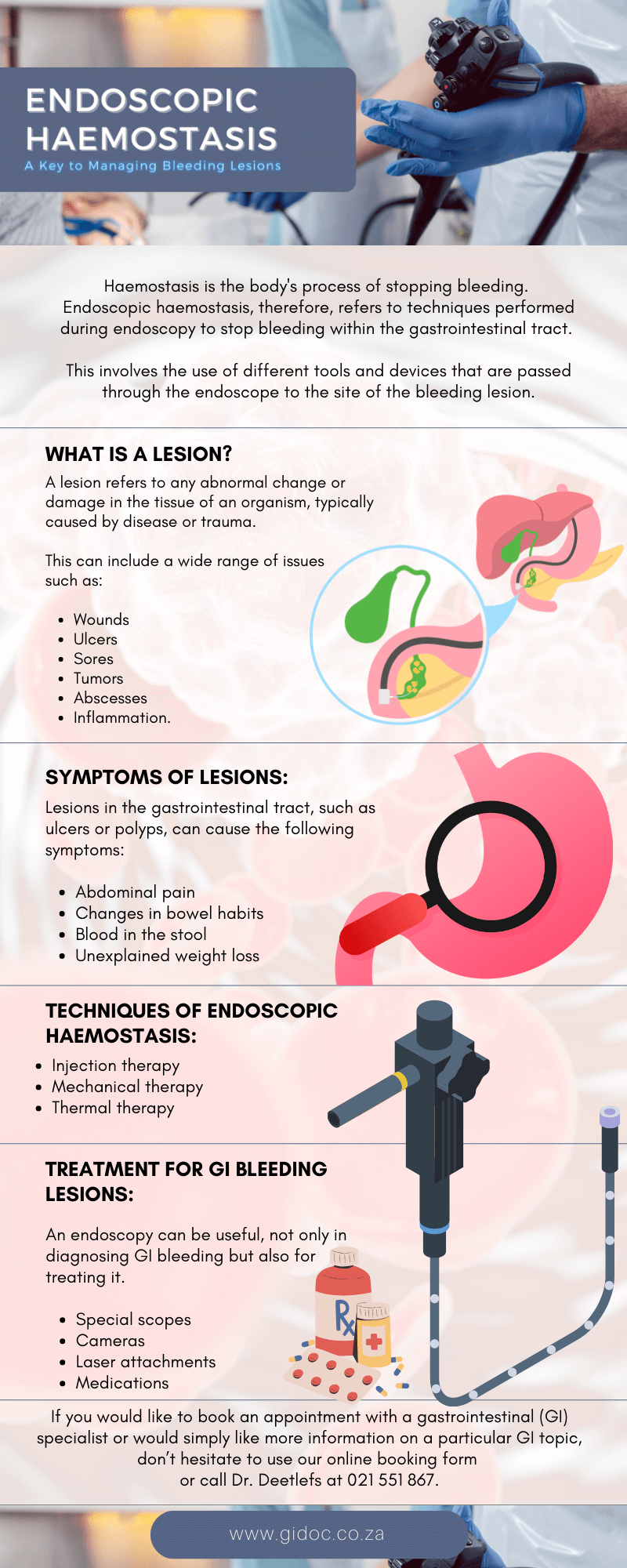
Endoscopic haemostasis, therefore, refers to techniques performed during endoscopy to stop bleeding within the gastrointestinal tract.

This involves the use of different tools and devices that are passed through the endoscope to the site of the bleeding lesion.

The management of GI bleeding has evolved over the years with endoscopic haemostasis becoming the cornerstone of therapy.

The primary goal is not only to stop active bleeding but also to prevent rebleeding.


haemostatis_bleeding


What is a Lesion?

A lesion refers to any abnormal change or damage in the tissue of an organism, typically caused by disease or trauma. This can include a wide range of issues such as wounds, ulcers, sores, tumors, abscesses, and areas of inflammation.

In the context of medical imaging, a lesion might be an area of tissue that has been damaged due to injury or disease, which could include cancer or infections.

This term does not indicate a specific type of tissue change or damage but is rather a broad term that can refer to a variety of issues.

The exact characteristics and implications of a lesion can greatly vary depending on factors such as the location, size, and cause of the lesion.

Some lesions may cause pain or discomfort, while others might be completely asymptomatic. Certain lesions can be easily identified through a physical examination, while others may require advanced imaging techniques for detection.


Symptoms of Lesions:

Lesions in the gastrointestinal tract, such as ulcers or polyps, can cause the following symptoms:

  • Abdominal pain
  • Changes in bowel habits
  • Blood in the stool
  • Unexplained weight loss

managing_bleeding_lesions


Techniques of Endoscopic Haemostasis

The choice of haemostasis technique largely depends on the location and nature of the bleeding lesion.

However, most procedures fall under one of three categories: injection therapy, mechanical therapy, and thermal therapy.

Injection Therapy:   This involves injecting a solution, such as adrenaline, directly into or around the bleeding vessel to constrict it and stop the bleeding.

Mechanical Therapy:   This includes methods like band ligation or clip placement, where the bleeding vessel is physically closed off to stop the bleeding.

Thermal Therapy:   Here, heat is applied to the bleeding site to coagulate the blood and stop the bleeding. Examples include argon plasma coagulation and electrocoagulation.

All these methods can be used alone or in combination, depending on the situation and the judgement of the endoscopist.


Treatment for GI Bleeding Lesions

An endoscopy can be useful, not only in diagnosing GI bleeding but also for treating it.

The treatment is called haemostasis of bleeding lesions and the idea is to stop the bleeding.

The use of special scopes with cameras and laser attachments, along with medications can be used to stop the bleeding.

In addition, your doctor can use tools alongside scopes to apply clips to the bleeding vessels to stop the bleeding.

If hemorrhoids are the cause of your bleeding, over the counter (OTC) treatments might work for you.

If you find that OTC remedies don’t work, your doctor might use a heat treatment to shrink your hemorrhoids.

If infection is the cause, then the doctor might prescribe antibiotics which are usually enough to treat infections.


endoscopy_bleeding_lesions


The Role of Endoscopic Haemostasis in Managing Bleeding Lesions

GI bleeding can be a life-threatening emergency, and rapid assessment and treatment are vital.

Endoscopic haemostasis is often the first line of treatment due to its high success rate, minimal invasiveness, and relatively low risk of complications.

Several types of bleeding lesions can be managed through endoscopic haemostasis. These include bleeding peptic ulcers, varices, angiodysplasia, and post-polypectomy bleeding.

For example, in the case of bleeding peptic ulcers, endoscopic haemostasis can achieve initial haemostasis in more than 90% of cases.

If the bleeding is from varices (abnormally dilated vessels), band ligation or sclerotherapy can be effectively used.


Limitations and Risks

While endoscopic haemostasis is a key intervention, it is not without its limitations and risks.

Complications, although rare, can occur. These can include perforation, infection, and, in the case of variceal band ligation, stricture formation.

There are also situations where endoscopic haemostasis may not be successful, such as in the presence of coagulopathy (a condition affecting the blood’s ability to clot).

In such cases, alternative or additional treatments such as radiological intervention or surgery may be needed.

Advancements in Endoscopic Haemostasis recent advancements in technology have led to the development of new devices and techniques that have improved the efficacy and safety of endoscopic haemostasis.

These include over-the-scope clips, haemostatic powders, and endoscopic suturing devices. These novel tools are broadening the scope and effectiveness of endoscopic haemostasis and providing physicians with a wider array of options to manage bleeding lesions.

Over-the-Scope Clips (OTSC):
Over-the-scope clips are larger than standard clips and are able to close larger defects and exert a higher compressive force. This has made them particularly effective in managing more substantial bleeding and deeper lesions. They are also highly beneficial in preventing rebleeding.

Haemostatic Powders:
Haemostatic powders are a relatively new innovation. These powders, when applied to a bleeding site, absorb water from the blood, concentrate the clotting factors, and help in the formation of a stable clot. They are particularly effective in managing diffuse bleeding and have shown excellent results in acute, non-variceal upper GI bleeding.

Endoscopic Suturing Devices:
These are innovative devices that enable physicians to stitch from within the GI tract, thus providing a new method to achieve haemostasis. While still not extensively used due to technical complexity, these devices offer an excellent non-surgical option for haemostasis in challenging scenarios.


endoscopy_infographic


Conclusion

Endoscopic haemostasis has undoubtedly become a cornerstone in the management of gastrointestinal bleeding.

The evolution of this field has resulted in a shift from more invasive procedures to minimally invasive endoscopic techniques, improving patient outcomes and recovery times. With the development of advanced tools and techniques, the capabilities of endoscopic haemostasis are continually expanding, thus offering more effective solutions for the management of bleeding lesions.

However, each case of GI bleeding is unique, and a successful outcome often depends on a combination of the endoscopist’s skill, the choice of technique, and individual patient factors.

As we move forward, further advancements in this field will undoubtedly provide even more efficient and safer methods of managing GI bleeding.

Gi Doc Cape Town is a practice founded to provide medical solutions in the area of gastroenterology.

Over the years, Dr Eduan Deetlefs has earned the reputation of a trusted health expert providing consultative, diagnostic, and therapeutic endoscopic and related services to patients in
Cape Town and beyond.

Dr Deetlefs has admitting rights and performs endoscopies at both Mediclinic Milnerton and Life Vincent Pallotti Hospitals.

Services include consultations for gastrointestinal and liver related diseases with a specific interest in inflammatory bowel disease and iron deficiency anaemia caused by obscure gastrointestinal bleeding.

He furthermore performs numerous more specialised procedures such as capsule endoscopy, double-balloon enteroscopy, ERCP and various interventional procedures including polypectomies for large polyps, haemostasis of bleeding lesions, ablation of Barrett’s oesophagus and placement of feeding tubes (PEG).

If you would like to book an appointment with a gastrointestinal (GI) specialist or would simply like more information on a particular GI topic, don’t hesitate to use our online booking form
or call Dr. Deetlefs at 021 551 867.

DISCLAIMER: PLEASE READ CAREFULLY

The information on this website is to provide general guidance. In no way does any of the information provided reflect definitive medical advice and self-diagnoses should not be made based on information obtained online. It is important to consult a Gastroenterologist or medical doctor regarding ANY and ALL symptoms or signs including, but not limited to: abdominal pain, haemorrhoids or anal / rectal bleeding as it may a sign of a serious illness or condition. A thorough consultation and examination should ALWAYS be performed for an accurate diagnosis and treatment plan. Be sure to call a physician or call our office today and schedule a consultation.

GIDoc Cape Town

Patient-focused GI treatments and procedures in Cape Town.

Monday-Friday 8AM-4PM.

Connect with Us

© Dr. Eduan Deetlefs, Registered Gastroenterologist, GI Doc Cape Town

Our website information is not intended or implied to be a substitute for professional medical advice, diagnosis or treatment. Please consult a doctor about your specific condition. Only a trained physician can determine an accurate diagnosis and proper treatment.
Unlocking the Mysteries of Fatty Liver Disease: Prevention, Management, and Recovery

Unlocking the Mysteries of Fatty Liver Disease: Prevention, Management, and Recovery

Overview

Fatty liver disease, also known as hepatic steatosis, is a condition characterized by the accumulation of fat in liver cells. It is often associated with obesity, high cholesterol, type 2 diabetes, and metabolic syndrome.

There are two types of fatty liver disease: non-alcoholic fatty liver disease (NAFLD) and alcoholic fatty liver disease (AFLD). Unlocking the mysteries of fatty liver disease involves understanding its prevention, management, and recovery.

In this blog we will discuss fatty liver disease, the prevention thereof, management and how you can recover from having fatty liver disease.


Fatty Liver Disease Explained

As mentioned, Fatty liver disease is a condition characterized by the accumulation of excess fat in the liver cells. It is divided into two main types: non-alcoholic fatty liver disease (NAFLD) and alcoholic fatty liver disease (AFLD).

Here’s a detailed explanation of each type, their causes, symptoms, diagnosis, and treatment.

Non-Alcoholic Fatty Liver Disease (NAFLD):

NAFLD is the most common type of fatty liver disease and occurs in people who consume little or no alcohol. It is often associated with obesity, insulin resistance, high blood sugar levels, and high levels of blood lipids (fats).

NAFLD can be further categorized into:

  • Simple fatty liver (steatosis):
    It is the mildest form of NAFLD and is characterized by the accumulation of fat in the liver cells without significant inflammation or liver cell damage.
  • Non-alcoholic steatohepatitis (NASH):
    NASH is a more severe form of NAFLD, where fat accumulation is accompanied by inflammation and liver cell damage. This can lead to liver fibrosis (scarring), cirrhosis, and eventually liver failure or liver cancer.

Alcoholic Fatty Liver Disease (AFLD):

AFLD is caused by excessive alcohol consumption, leading to fat accumulation in liver cells.

It can progress to alcoholic hepatitis (inflammation and liver cell damage) and eventually cirrhosis or liver cancer if alcohol consumption continues.

fatty_liver_disease_managment

Causes of Fatty Liver Disease

Fatty liver disease occurs when the liver cannot efficiently break down or process fats, causing them to accumulate in liver cells. Factors contributing to fatty liver disease include:

  • Excessive alcohol consumption (AFLD)
  • Obesity
  • Insulin resistance or type 2 diabetes
  • High blood lipid levels (cholesterol and triglycerides)
  • Rapid weight loss
  • Certain medications
  • Genetic factors

Symptoms

Fatty liver disease often has no symptoms in its early stages. As the condition progresses, symptoms may include:

  • Fatigue
  • Weakness
  • Unexplained weight loss
  • Upper abdominal pain or discomfort
  • Enlarged liver (hepatomegaly)
  • Jaundice (yellowing of the skin and eyes)
  • Swelling in the legs and abdomen (ascites)


Diagnosis

Fatty liver disease can be diagnosed through various tests, including:

  • Physical examination: The doctor may detect an enlarged liver during a physical examination.
  • Blood tests: Liver function tests (LFTs) can help assess liver health and detect elevated liver
    enzymes, which may indicate inflammation or liver damage.
  • Imaging studies: Ultrasound, CT scan, or MRI can reveal fat accumulation in the liver.
  • Liver biopsy: A small tissue sample is taken from the liver to confirm fatty liver disease and assess the extent of liver damage.

Treatment

There is no specific medication for treating fatty liver disease. Management primarily involves lifestyle changes and addressing underlying conditions:

  • Weight loss through a healthy diet and regular exercise
  • Blood sugar control for individuals with diabetes
  • Management of blood lipid levels
  • Avoiding alcohol (especially in AFLD)
  • Treating other underlying conditions, such as hepatitis or thyroid disorders

In severe cases, a liver transplant may be necessary if cirrhosis or liver failure occurs.


alcoholic_fatty_liver_disease

Prevention

To prevent fatty liver disease, it is essential to maintain a healthy lifestyle. This includes:

  • Eating A Balanced Diet:
    Incorporate fruits, vegetables, whole grains, lean proteins, and healthy fats while avoiding processed foods, excessive sugar, and saturated fats.
  • Regular exercise:
    Engage in physical activities for at least 150 minutes per week, including cardiovascular exercises and strength training.
  • Maintaining a healthy weight:
    Obesity is a significant risk factor for fatty liver disease, so strive to achieve and maintain a healthy weight.
  • Limiting alcohol intake: Excessive alcohol consumption can lead to AFLD, so be mindful of your alcohol consumption and follow recommended guidelines.
  • Regular check-ups: Monitor your liver health through regular check-ups and blood tests, especially if you have risk factors for fatty liver disease.

fatty_liver_disease_managent

Management

If you are diagnosed with fatty liver disease, proper management is crucial to prevent its progression. Some steps include:

  • Weight loss: Gradual and sustained weight loss through a combination of diet and exercise can help reduce fat accumulation in the liver.
  • Blood sugar control: If you have diabetes, maintaining proper blood sugar levels is essential to prevent further liver damage.
  • Cholesterol management: Monitor and manage your cholesterol levels through diet, exercise, and, if necessary, medication.
  • Avoiding toxins: Limit exposure to liver-damaging substances, such as alcohol and certain medications.

Recovery

Reversing fatty liver disease is possible with consistent lifestyle changes and medical intervention.

Some key factors in recovery include:

  • Continued weight loss and maintenance
  • Sustained weight loss can help improve liver function and reduce fat accumulation.
  • Ongoing lifestyle changes. Consistently follow a healthy diet, exercise regularly, and limit alcohol intake to support liver recovery.
  • Medical treatment: In some cases, medications may be prescribed to help manage underlying conditions contributing to fatty liver disease, such as diabetes or high cholesterol.
  • Monitoring progress: Regular check-ups and blood tests are crucial to track your liver’s recovery and ensure that fatty liver disease does not progress.

Understanding the prevention, management, and recovery of fatty liver disease is crucial in addressing this increasingly common health issue.

Lifestyle modifications and proper medical care can help prevent and reverse the condition, improving liver health and overall well-being.

liver_disease_infographic

Conclusion

In conclusion, fatty liver disease is a prevalent condition characterized by the accumulation of excess fat in the liver cells.

It has two main types: non-alcoholic fatty liver disease (NAFLD) and alcoholic fatty liver disease (AFLD).

The condition often has no symptoms in its early stages but can progress to more severe forms, leading to complications such as liver fibrosis, cirrhosis, and liver failure.

Prevention and management of fatty liver disease primarily revolve around adopting a healthy lifestyle, including maintaining a balanced diet, engaging in regular exercise, achieving and maintaining a healthy weight, and limiting alcohol intake.

In addition, it is crucial to address underlying health conditions, such as diabetes and high cholesterol, to prevent the progression of the disease.

Early detection through regular check-ups, blood tests, and imaging studies is essential for timely intervention and management. Although there is no specific medication for fatty liver disease, lifestyle changes and proper medical care can effectively manage and even reverse the condition, ultimately improving liver health and overall well-being.

Dr. Deetlefs has earned the reputation of a trusted health expert providing consultative, diagnostic, and therapeutic endoscopic and related services to patients in Cape Town and beyond.

Dr Eduan prides himself on his ability to help his patients to the best of his ability by embracing good listening skills, effective communication, compassion and knowledge and skill honed during years of private gastroenterology practice.

If you would like to book an appointment with a gastrointestinal (GI) specialist or would simply like more information on a particular GI topic, don’t hesitate to use our online booking form
or call Dr. Deetlefs at 021 551 867. 

DISCLAIMER: PLEASE READ CAREFULLY

The information on this website is to provide general guidance. In no way does any of the information provided reflect definitive medical advice and self-diagnoses should not be made based on information obtained online. It is important to consult a Gastroenterologist or medical doctor regarding ANY and ALL symptoms or signs including, but not limited to: abdominal pain, haemorrhoids or anal / rectal bleeding as it may a sign of a serious illness or condition. A thorough consultation and examination should ALWAYS be performed for an accurate diagnosis and treatment plan. Be sure to call a physician or call our office today and schedule a consultation.

GIDoc Cape Town

Patient-focused GI treatments and procedures in Cape Town.

Monday-Friday 8AM-4PM.

Connect with Us

© Dr. Eduan Deetlefs, Registered Gastroenterologist, GI Doc Cape Town

Our website information is not intended or implied to be a substitute for professional medical advice, diagnosis or treatment. Please consult a doctor about your specific condition. Only a trained physician can determine an accurate diagnosis and proper treatment.