021 202 0626
Colonoscopy: What to Expect by Dr. Deetlefs – Cape Town

Colonoscopy: What to Expect by Dr. Deetlefs – Cape Town

About Dr. Deetlefs and his Practice


GiDoc Capetown
is a practice founded to provide medical solutions in the area of gastroenterology.

Over the years, Dr Eduan Deetlefs has earned the reputation of a trusted health expert providing consultative, diagnostic, and therapeutic endoscopic and related services to patients in Cape Town and beyond.

Dr Eduan has a wealth of up-to-date knowledge in the management of inflammatory bowel disease and in addition he has a trial centre, Spoke Research Inc, that specialises in biological trials for inflammatory bowel disease.

Services include consultations for gastrointestinal and liver related diseases with a specific interest in inflammatory bowel disease and iron deficiency anaemia caused by obscure gastrointestinal bleeding.

He furthermore performs numerous more specialised procedures such as capsule endoscopy, double-balloon enteroscopy, ERCP and various interventional procedures including polypectomies for large polyps, haemostasis of bleeding lesions, ablation of Barrett’s oesophagus and placement of feeding tubes (PEG).

Let’s dig deeper into one of his most specialised procedures:  The Colonoscopy.
 

Colonoscopy Explained


Dr Eduan sees the whole spectrum of gastrointestinal and liver-related diseases with a special interest in inflammatory bowel disease and anaemia caused by obscure intestinal bleeding.

He performs numerous procedures including diagnostic and therapeutic gastroscopies and colonoscopies.

Millions of people have a colonoscopy every year. Here’s how it works and what to expect.

A colonoscopy is an examination of the rectum and colon to look for polyps, bleeding, ulcers and other abnormal areas that can be removed before they become cancerous. 

The colonoscope used for a colonoscopy has a camera on the end that transmits what you see inside your colon onto a large screen in the exam room. Since a colonoscopy allows doctors to directly see any abnormalities within the digestive tract, specialized tests that require biopsies aren’t needed as often. 

This means you’ll have fewer test procedures so the procedure itself is usually shorter than other diagnostic tests for similar conditions.

Also, because polyps grow over time, it’s easier to find them during examinations than it would be using non-invasive methods like virtual colonoscopies or CT scans since they’re usually too small to detect on these technologies. 

Most patients are sedated during this test, so there isn’t much discomfort involved.

The procedure typically takes about 30 to 60 minutes.

 

reasons_why_you_might_need_a_colonoscopy

Reasons Why You Might Need a Colonoscopy

When you need to boost your colon health, you’ll have many options in terms of ways to do so. One of the best known procedures is a colonoscopy. But why should you get one?

To begin with, it allows for early detection of cancerous growths that may otherwise go undetected without intervention and be treated accordingly.

It also allows patients who suffer from chronic constipation to determine whether their issue might be a result of intestinal polyps that can then be surgically removed from the bowel without causing further problems later on.

Finally, it is also capable of detecting Crohn’s disease or ulcerative colitis and may allow proper measures to be followed in an attempt to prevent further complications before they begin to appear and might otherwise require painful surgery or extreme measures later on if left untreated early on in life.

The most common reasons for colonoscopy are to evaluate the following:

  • As a screening exam for colon cancer
  • Rectal bleeding
  • A change in bowel habits, like persistent diarrhea
  • Iron deficiency anemia (a decrease in blood count due to loss of iron)
  • A family history of colon cancer
  • As a follow-up test in people with colon polyps or colon cancer
  • Chronic, unexplained abdominal or rectal pain
  • An abnormal X-ray exam, like a barium enema or CT scan 

colonoscopy_by_dr_deetlefs


The Importance of Getting a Colonoscopy

As the cliché goes, “prevention is better than cure”.

Colonoscopy might seem like a scary medical procedure, but it’s one that prevents you from being diagnosed with colon or colorectal cancer too late and suffering because of it.

Fear about your health should never be an excuse not to get regular check-ups. Prevention is important to keep yourself healthy and prevent unnecessary costs in the future.

After all, at the end of the day you’ll only get out what you put in. You need to take some action in order to benefit from this. 

How to Get Ready for a Colonoscopy

Having an adequate preparation for a colonoscopy is essential for getting the best results, while increasing the least amount of discomfort.

You will have to make sure that your bowels are empty prior to your procedure by having a good bowel movement in the morning, and some people opt for going through an enema procedure before scheduling their colonoscopy.

If you’re diabetic or on a special diet, then you need to inform your gastro-intestinal specialist about what medications and supplements you’re on.

This could be important for determining which type of laxatives are safe to use prior to a scheduled procedure – usually the night before, rather than early morning. 

colonoscopy_explained_gidoc_cpt


What To Expect After a Colonoscopy

After a Colonoscopy, you may experience some noticeable discomfort in the first few days, following which your bowel motions will re-establish their normal pattern. 

There are many myths and misconceptions that surround having a colonoscopy. Most people are not aware of some of the common side effects after a colonoscopy.

On the patient side of things, there are a few potential side effects that could occur following a colonoscopy that are unpleasant to experience.

The most common side effect after a colonoscopy is vomiting. This happens because food or fluid comes into contact with the intestines when the colon is being cleansed.

As it leaves the body, the food or fluid passes through the body and exits via the bowel. 

If a person experiences abdominal pain, cramping, or fever, it could be a sign of a side effect of this procedure.

Other potential side effects of the colonoscopy include: 

  • Dizziness
  • Depression
  • Diarrhea
  • Loss of appetite
  • Dry mouth
  • Yawning
  • Low blood pressure
  • Fever

If any side effects do not go away, it is a good idea to see a doctor to rule out other possible causes. While most people go home from the colonoscopy fine, a small percentage of people have side effects. 

Colonoscopy What to Expect by Dr. Deetlefs CPT

Get in Touch with GI Expert Dr. Deetlefs

Dr Deetlefs has admitting rights and performs endoscopies at both Mediclinic Milnerton and Life Vincent Pallotti Hospitals.

To learn more about the complexity of your gut and the opportunity for you to contribute to the scientific pursuit of gastrointestinal knowledge, visit our Cape Town office or visit our website.

We are gastroenterologist experts using patient-focused GI treatment and procedures in Cape Town.

If you haven’t been scheduled for a colonoscopy and want to get one, make an appointment now. 

GIDoc Cape Town

Patient-focused GI treatments and procedures in Cape Town.

Monday-Friday 8AM-4PM.

Connect with Us

© Dr. Eduan Deetlefs, Registered Gastroenterologist, GI Doc Cape Town

Our website information is not intended or implied to be a substitute for professional medical advice, diagnosis or treatment. Please consult a doctor about your specific condition. Only a trained physician can determine an accurate diagnosis and proper treatment.

IBD: Causes, Symptoms and Treatment

IBD: Causes, Symptoms and Treatment

ibs-treatment-in-cape-town


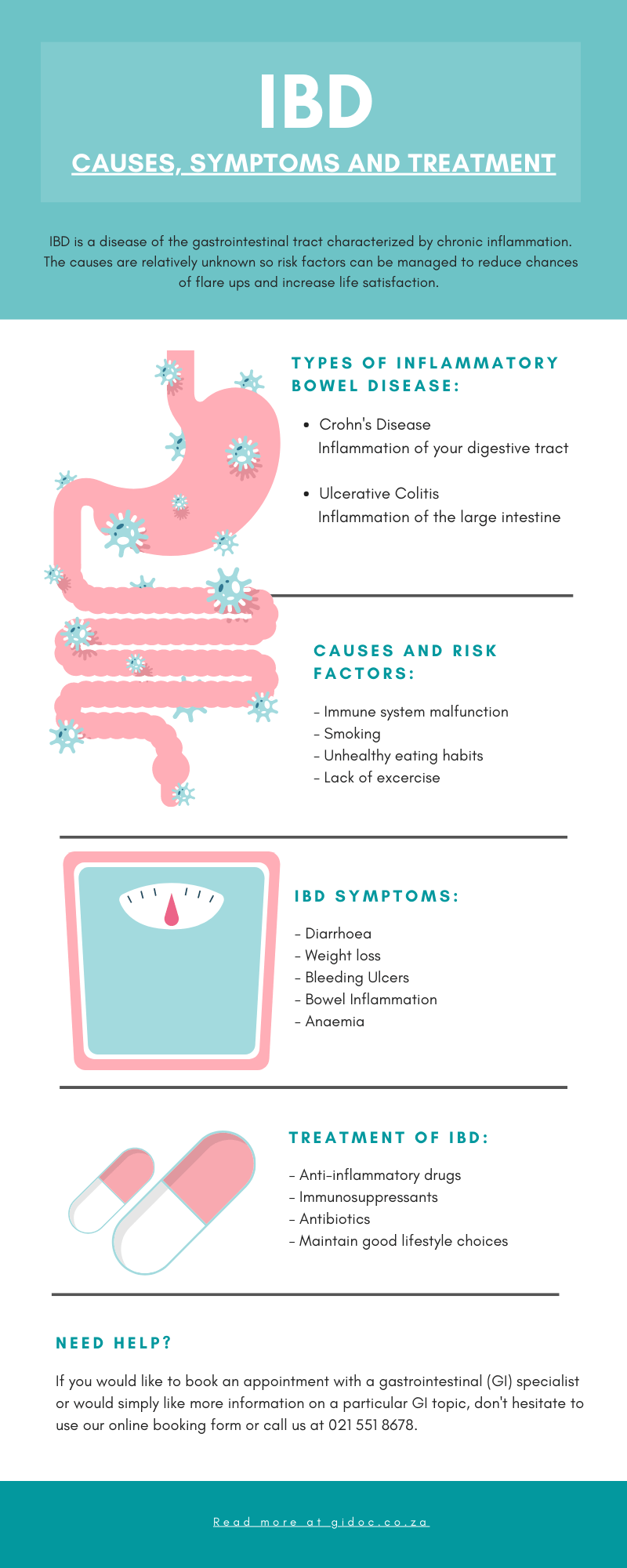
IBD is a disease of the gastrointestinal tract characterized by chronic inflammation.  The causes are relatively unknown so risk factors can be managed to reduce chances of flare ups and increase life satisfaction. 

Here we look at the causes, typical symptoms, and possible treatments.

Overview


Inflammatory bowel disease is referred to as an umbrella term which is used to describe disorders that involve chronic inflammation of the digestive tract. 

In other words, inflammation that remains for a long period of time with periods of flare ups interlaced with periods of remission. 

The digestive tract comprises the mouth, oesophagus, stomach, small intestine, and large intestine. It’s responsible for breaking down your food, extracting the nutrients, and getting rid of waste material. 

In times gone by, IBD has been thought to be a type of autoimmune disease but, as more research is published, there are suggestions that the chronic inflammation is not due to an attack on your body by your immune system. 

Rather, the inflammation is believed to be caused by one’s immune system attacking bacteria or food in the gut which then leads to inflammation. 

In the article, we’re going to explore IBD in terms of its causes, symptoms and treatments for a better overall understanding of the disease.


ibd_causes_treatment_and_symptoms


The Different Types of Inflammatory Bowel Disease


Before we jump into the causes, symptoms, and treatment of IBD, it’s first important to state and understand the two main categories of IBD. 

IBD is split into two main categories: ulcerative colitis and Crohn’s disease. 

Ulcerative colitis involves inflammation of the large intestine with inflammation only present in the innermost layer of the lining of the colon. 

Apart from inflammation, ulcerative colitis can also present as sores, or ulcers, on the colon lining. Another characteristic of this form of IBD is that the damaged areas are continuous. 

This is in contrast to how Crohn’s disease presents. 

Whereas ulcerative colitis is limited to the large intestine, Crohn’s disease can involve any part of the gastrointestinal tract from the mouth all the way to the end – the anus. 

Most commonly, it develops in the final part of the small intestine and colon. Another differentiating factor is that it occurs in distinct patches. 

Unlike the continuous inflammation found in ulcerative colitis patients, those suffering from Crohn’s disease present with quite distinct healthy and inflamed areas of tissue. 

Crohn’s disease seems to be increasing in occurrence with time – studies in the United States suggest that over half a million people are suffering from the disease. 

The distinction between the two forms of IBD is not always crystal clear. 

When a doctor is unable to determine whether a patient has ulcerative colitis or Crohn’s disease, they will classify the patient’s condition as “indeterminate colitis” implying that there are cases where it’s not always clear one way or the other. 

This is a good place to have a momentary aside and talk about irritable bowel syndrome and compare it with irritable bowel disease.

Many similarities between the two can make it more difficult to tell them apart.

 For one, they both lead to changes in bowel habits accompanied with pain in the abdomen.

 In terms of symptom occurrence, it can flare-up for short periods where there is a lot more physical discomfort and suffering followed by longer periods of remission. 


ibd_treatment_causes_symptoms


Causes and Risk Factors for Inflammatory Bowel Disease


The exact cause of inflammatory bowel disease is unknown and, taking the extreme complexity of the gut and its microbiome, this fact isn’t all that surprising. 

One cause that might be likely is one of immune system malfunction. In this case, your immune system targets and attacks cells in the digestive tract which has an inflammatory side-effect. 

The fact that the exact cause is unknown warrants a closer look at known risk factors. 

As the saying goes – “prevention is better than cure”. 

There are some lifestyle choices which can significantly lower your risk of developing irritable bowel disease. 

Age-old advice goes a long way here: Eat healthy foods and exercise regularly. 

In terms of risk factors, one of the main culprits is smoking. 

Smoking, in general, is a terrible thing for the body which affects almost every part of your living system. In terms of IBD, smoking is one of the chief risk factors for developing Crohn’s disease. 

Apart from increasing your risk, smoking increases the pain patients which experience when they already have Crohn’s disease and it results in a higher chance of complications. 

Age is less of a risk factor than with other diseases with most cases of IBD presenting before a patient is thirty-five years old. Gender also does not play much part here with both males and females generally being affected equally by IBD. 

Your geographical region (where you live) plays a predicted role in determining whether you will develop IBD or not. Those living in urbanized areas have a higher chance of getting IBD which can somewhat be explained by lifestyle choices and a diet consisting of more fat and processed food. 

Alright, so we’ve established some of the risk factors. Now it’s time to look into possible treatments available.


Inflammatory Bowel Disease Symptoms


Naturally, the symptoms of IBD vary according to the location of the disease, its severity and the type. As mentioned earlier, symptom onset can flare-up more intensely, with variations of course, and then settle down into remission for a longer period. 

While inflammation is the main concern with IBD, it can be difficult to realize that it’s a problem. For that, we need to look at other symptoms that can occur in the body such as the following: 

  • Diarrhoea which occurs due to the inflamed part of the bowel being unable to reabsorb water thus leaving an excess that the body must rid itself of.
  • Weight loss and anaemia as a result of the poor reabsorption of nutrients, patients can experience a loss in weight which can cause delayed developmental growth in children.
  • Bleeding ulcers are another indicating symptom which can cause blood to show up in the stool.
  • Bowel inflammation and obstruction also result in stomach pain, cramping, and bloating.

 Apart from these, IBD has been associated with issues outside of the digestive system such as eye inflammation, skin disorders, and arthritis.  

ibd_symptoms_and_treatment_options


Treatment for Inflammatory Bowel Disease


Due to the inflammation being the main problem in IBD with cascading effects, anti-inflammatory drugs are the first step in an IBD treatment plan. 

Apart from reducing inflammation, it’s important to lower the immune response in an attempt to stop the immune system from attacking the bowel which causes inflammation. Immunosuppressants are administered for this. 

There are risks of side-effects so doctor consultation is important to establish the right medication on a case-by-case basis. 

Antibiotics can also be administered to target bacteria that may be triggering or worsening IBD symptoms. 

Once the main symptoms have been dealt with, it’s important to maintain good lifestyle choices to further reduce symptoms and risk of re-onset. 

This includes addressing the loss of fluid by drinking plenty of water and avoiding potential bowel irritants such as dairy products.

In some cases, surgery can be necessary.

For people with Crohn’s disease, surgery can be a means used to remove affected parts of the intestine while severe cases of ulcerative colitis may require the removal of the entire colon and rectum. 


IBD_causes_symptoms_and_treatment


What’s Next?

If you would like to book an appointment with a gastrointestinal (GI) specialist or would simply like more information on a particular GI topic, don’t hesitate to use our online booking form or call us at 021 551 8678.

We’re always happy to help you understand the oftentimes confusing world of the gut and its relation to our overall health.

GIDoc Cape Town

Patient-focused GI treatments and procedures in Cape Town.

Monday-Friday 8AM-4PM.

Connect with Us

© Dr. Eduan Deetlefs, Registered Gastroenterologist, GI Doc Cape Town

Our website information is not intended or implied to be a substitute for professional medical advice, diagnosis or treatment. Please consult a doctor about your specific condition. Only a trained physician can determine an accurate diagnosis and proper treatment.

The Importance of Maintaining a Healthy Gut

The Importance of Maintaining a Healthy Gut

Our guts are unbelievably complex. As more light is shed on this complexity by an ever-expanding body of scientific research, we are finding compelling evidence of links between the gut and a multitude of other bodily functions and features.

Numerous studies have found such links between gut health and mental health, skin conditions, the immune system, your general mood, and even cancer.

Once thought to be relatively simple in function, our guts are proving to be important catalysts for overall body health and normal functioning.

This incredibly intricate network of interaction is due to what is referred to as the gut microbiome.

Basically, your gut microbiome refers to the hundreds of different species of bacteria and yeast that live in your digestive tract. Many of these are wonderfully beneficial to our human bodies and some are, in fact, necessary for a healthy, functioning physiological system.

By looking after the health of your gut, you’re taking care of the good bacteria that reside there and impart beneficial effects on the rest of your body.

Here we are going to take a look at some of the ways in which you can detect if your gut health is struggling.

We will then talk about some of the benefits of maintaining good gut health and, finally, we’ll suggest some ways in which you can increase your chances of having the healthiest gut possible.

signs_of_an_unhealhty_gut

Signs of an Unhealthy Gut

Modern life is, as expected, not great for our gut health.

Many key features of today’s society result in many, if not most, people living with high-stress levels, operating on too little sleep, taking antibiotics, and eating highly processed foods.

None of this bodes well for the gut health of modern humans as poor gut health has a knock-on effect on many other aspects of your general health with your brain, heart, immune system, hormone levels, and mental health all susceptible to an increased likelihood of problems occurring.

Poor gut health can manifest itself in several ways.

Here are some common signs that may give you an indication that your gut is in need of some TLC.

1. Food Intolerances

Different from food allergies, food intolerance is the result of the difficulty in digesting a certain food (as opposed to the immune system reaction in food allergies).

Research indicates that this is due to the poor quality of gut bacteria. Ways in which this can manifest physically is through bloating, gas, diarrhoea, abdominal pain, and nausea.

2. Upset Stomach

General stomach disturbances such as those mentioned in the previous point, all point to something gone awry in your gut health. Constipation and heartburn are some extra signs indicating that your gut is having difficulty processing food and getting rid of the necessary waste.

3. Unintentional Weight Changes

The important word to take note of here is “unintentional”. If you are losing or gaining weight without changes in your diet or exercise routine, you may have a sign of an unhealthy gut on your hands.

When your gut health is suffering, your body will have a reduced ability to effectively absorb all the key nutrients from foods, regulate your blood sugar, and store fat.

Weight loss may be caused by small intestinal bacterial overgrowth (SIBO), while weight gain can be caused by insulin resistance or a nagging urge to overeat due to insufficient nutrient absorption.

4. Irregular Sleep Patterns and Nagging Fatigue

Insomnia and low sleep-quality may be the result of an unhealthy gut. Serotonin, largely produced in your gut, plays a large role in your mood regulation and sleep.

Therefore, an unhealthy gut may result in poorly regulated serotonin production thereby affecting your sleep quality.

How to Maintain a Healthy Gut

Now that we have taken a closer look at some of the real negative aspects of having poor gut health, let us look at how to improve and maintain good gut health.

Some of these may sound easy while others may challenge your willpower somewhat.
Start with at least a few and slowly work your way up if implementing all of them at once is a little overwhelming.

1. Eat a Healthy Diet

Eating a healthy balanced diet  results in lower gut inflammation and xhelps the gut microbiome thrive.

2. Avoid Smoking

While this may be a no-brainer to some, it is worth listing here.

Smoking is bad for you in every way, including your gut health.

Smoking negatively affects one’s gut microbiome by increasing the number of potentially harmful microorganisms while decreasing the levels of beneficial bacteria.

Consequently, those who smoke have an increased risk of developing intestinal conditions such as inflammatory bowel disease (IBD).

3. Take Probiotics and Eat Fermented Food

Some research suggests that regularly taking a probiotic, found in health food stores and pharmacies, can support a healthy gut microbiome and that it may even serve as a preventive measure for developing gut inflammation and other intestinal problems.

For those who want to ingest one less, not one more, pill a day – look towards foods that are a natural source of probiotics. Consuming fermented vegetables, kombucha, sauerkraut and miso regularly may improve gut health significantly.

4. Eat More Prebiotic Fibre

Non-digestible carbohydrates are referred to as prebiotics and they are essential for the generation of beneficial bacteria in the gut.

How?

Well, probiotics feed on this prebiotic fibre which, in turn, help grow and maintain a healthy gut microbiome.

Research has also shown that prebiotics may help probiotics become more tolerant to certain environmental conditions such as changes in PH and temperature.

5. Reduce Stress

One of the chief villains contributing to an unhealthy gut, stress, or the lack thereof rather, is very important for keeping your gut microflora healthy and happy.

Psychological stressors have been shown to have disruptive effects on the proliferation of healthy gut bacteria, even if the stress is temporary.

The solution is to find ways to manage your stress so that your gut microbiome is less susceptible to sudden changes due to temporary stress.

Chronic stress is even worse highlighting the case for its mitigation.

Some key stressors that affect your gut health include sleep deprivation, environmental stressors such as extreme noise pollution and intense temperature changes, and general psychological stress.

A few useful habits or activities worth looking into for the sake of reducing stress include meditation, deep breathing exercises, and focused muscle relaxation.

For the sake of completeness, it’s important to remember that simply sticking to a sleep schedule and exercising regularly can do wonders for lowering your stress levels.

6. Take Antibiotics Only When Absolutely Necessary

The overuse of antibiotics is a significant public health concern that may eventually lead to antibiotic resistance.

Apart from that, however, antibiotics are, by very nature, damaging to gut bacteria with research showing that the gut can lack the beneficial bacteria even up to six months after antibiotic use.

Always consult with your doctor about the necessity of taking an antibiotic so that alternative options may be discussed if they are available and effective.

healthy-gut-microbiome1

Summary

Our gut microbiome is incredibly complex with interactions among trillions of bacteria, yeast, and viruses affecting us in a multitude of different ways from our mental health, immune system response, and even our propensity for developing cancer.

While modern life makes it terribly easy to pepper our gut with unhealthy effects, there are beneficial means at our disposal.

By combining a conscious diet choice with good sleep, regular exercise, and stress-reducing habits, we are able to cultivate an environment for our gut that results in healthy gut bacteria thriving and harmful bacteria dying.

To learn more about the complexity of your gut and the opportunity for you to contribute to the scientific pursuit of gastrointestinal knowledge, visit our Cape Town office or peruse our website.

We are gastroenterologist experts using patient-focused GI treatment and procedures in Cape Town.


GIDoc Cape Town

Patient-focused GI treatments and procedures in Cape Town.

Monday-Friday 8AM-4PM.

Connect with Us

© Dr. Eduan Deetlefs, Registered Gastroenterologist, GI Doc Cape Town

Our website information is not intended or implied to be a substitute for professional medical advice, diagnosis or treatment. Please consult a doctor about your specific condition. Only a trained physician can determine an accurate diagnosis and proper treatment.